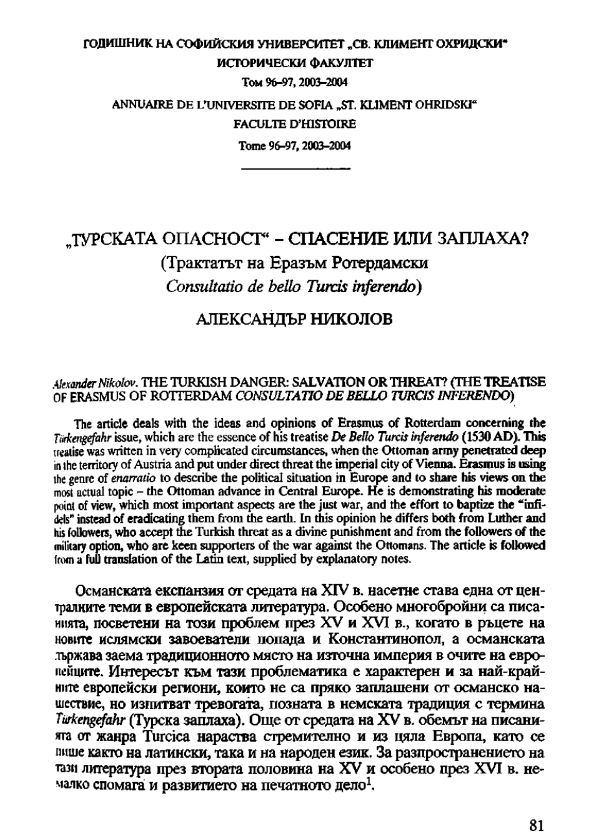
The Turkish Danger: Salvation or Threat? The Treatise of Erasmus Rotterdam Consultatio de bello Turcis inferendo
DOI:
https://doi.org/10.60053/GSU.IF.1.97.81-125Keywords:
Erasmus of Rotterdam, Ottoman threat, Vienna, Just WarAbstract
Тhе article deals with the ideas and opinions of Erasmus of Rotterdam concerning the Türkengefahr issue, which are the essence of his treatise De Bello Turcis inferendo (1530 AD). This treatise was written in very complicated circumstances, when the Ottoman army penetrated deep in the territory of Austria and put under direct threat the imperial city of Vienna. Erasmus is using the genre of enarratio to describe the political situation in Europe and to share his views on the most actual topic - the Ottoman advance in Central Europe. Не is demonstrating his moderate point of view, which most important aspects are the just war, and the effort to baptize the "infidels" instead of eradicating them from the earth. In this opinion he differs both from Luther and his followers, who accept the Turkish threat as а divine punishment and from the followers of the military option, who are keen supporters of the war against the Ottomans. The article is followed from а full translation of the Latin text, supplied bу explanatory notes.
References
1 Вж: Göllner, C. Turcica. Die europäischen Türkendrucke des XVI. Jahrhunderts. T. 1. Bucureşti – Berlin, 1961; T. 2. Bucureşti – Baden-Baden, 1968; T. 3. Bucureşti – Baden-Bad, където подробно са анализирани редица писания по „Турската опасност“ от XVI в.
2 За схоластическите виждания за ролята на исляма: Norman, D. The Islam and the West: The Making of An Image. Oxford, 1960, passim.
3 „Utilissimus consultatio de bello Turcis inferendo et obliter enarratus Psalmus XXVIII per Des. Erasmum Roterdamum“, Basileae, in officina Frobeniana, 1530.
4 Йоханес Рикх произхождал към позната фамилия, но за него се знае твърде малко. Той произхождал от сравнително заможно семейство и следвал право в Кьолн и Болоня. От 1528 до около 1560 г. е преподавател по юриспруденция в Кьолн. Вж. Stupperich, R. Einleitung, p. 5.
5 Desiderii Erasmi Roterodami. Opera omnia, ordinis quinti. T. 3, 1986, North Holland Amsterdam – New York – Oxford – Tokyo: Enarrationes in Psalmos: Consultatio de bello Turcico, herausgegeben von R. Stupperich (1–81 pp.). Подробен анализ на произведението, коментара на историческия и литературния контекст, на публикацията на текста и на предговорите води това съчинение във Въведението (Einleitung), 1–28. Специална благодарност дължа на колегата доц. д-р Иван Гърбев, който бе така любезен да ми предостави текста на трактата и коментара на проф. Щуперих.
Амвросий Медиолански (Ambrosius Mediolanensis). De obitu Theodosii oratio (Sanc. Ambrosii oratio de obitu Theodosii). Washington D.C., 1925, p. 57, II, 6–8; Migne, PL, 16, 1396–1397.
Августин Блажени (Aurelius Augustinus). Epistulae, 149, Migne, PL, 33.
Апостол Павел. Послание до римляните (13:4); Първо послание до коринтяните (5:12; 7:9; 12:7); Послание до ефесяните (4:14).
Гай Плиний Секунд – Плиний Стари (Plinius Secundus Maior). Naturalis historia.
География на Клавдий Птолемей (Claudius Ptolemaeus). Geographia. Кн. V, 8, §13.
Давид, цар Израилев. Псалми (94:7–10; 95:8–10; 29:1–9).
Деuteronomium (Второзаконие), XXVIII, 30.
Евреите. Послание до ефесяните, 4:14.
Исая. Пророчество, 9:3.
Йов (Job). – (не е цитиран, но споменат в контекста на моралните книги на Стария завет – запазен за контекст).
Квинт Септимий Тертуллиан (Quintus Septimius Tertullianus). De fuga in persecutione.
Киприан Картагенски (Cyprianus Carthaginensis). De duplici martyrio.
Матеево евангелие (Matthaeus). 3:2 – „Agite poenitentiam, instat regnum coelorum!“
Мела, Помпоний (Pomponius Mela). De chorographia. Около 40 г. сл. Хр.
Орaции на Хораций (Horatius Flaccus). Carmina, II, 1, 36: „Quae caret ora cruore nostro?“; Epistulae, I, 18, 84: „Tunc tua res agitur paries quum proximus ardet.“
Псалтир (Psalmi). 29, 94, 95.
Свети Амвросий (Ambrosius Mediolanensis). De obitu Theodosii oratio.
Свети Киприан Картагенски (Sanctus Cyprianus). De duplici martyrio.
Свещено писание – Библия. Левит, 26:43–44; Псалми, 29:3–9; Ефесяни, 4:14; Римляни, 13:4; Коринтяни, 5:12, 7:9; Исая, 9:3; Матей, 3:2.
1 Vzh: Göllner, C. Turcica. Die europäischen Türkendrucke des XVI. Jahrhunderts. T. 1. Bucureşti – Berlin, 1961; T. 2. Bucureşti – Baden-Baden, 1968; T. 3. Bucureşti – Baden-Bad, kadeto podrobno sa analizirani reditsa pisania po „Turskata opasnost“ ot XVI v.
2 Za sholasticheskite vizhdania za rolyata na islyama: Norman, D. The Islam and the West: The Making of An Image. Oxford, 1960, passim.
3 „Utilissimus consultatio de bello Turcis inferendo et obliter enarratus Psalmus XXVIII per Des. Erasmum Roterdamum“, Basileae, in officina Frobeniana, 1530.
4 Yohanes Rikh proizhozhdal kam poznata familia, no za nego se znae tvarde malko. Toy proizhozhdal ot sravnitelno zamozhno semeystvo i sledval pravo v Kyoln i Bolonya. Ot 1528 do okolo 1560 g. e prepodavatel po yurisprudentsia v Kyoln. Vzh. Stupperich, R. Einleitung, p. 5.
5 Desiderii Erasmi Roterodami. Opera omnia, ordinis quinti. T. 3, 1986, North Holland Amsterdam – New York – Oxford – Tokyo: Enarrationes in Psalmos: Consultatio de bello Turcico, herausgegeben von R. Stupperich (1–81 pp.). Podroben analiz na proizvedenieto, komentara na istoricheskia i literaturnia kontekst, na publikatsiyata na teksta i na predgovorite vodi tova sachinenie vav Vavedenieto (Einleitung), 1–28. Spetsialna blagodarnost dalzha na kolegata dots. d-r Ivan Garbev, koyto be taka lyubezen da mi predostavi teksta na traktata i komentara na prof. Shtuperih.
Amvrosiy Mediolanski (Ambrosius Mediolanensis). De obitu Theodosii oratio (Sanc. Ambrosii oratio de obitu Theodosii). Washington D.C., 1925, p. 57, II, 6–8; Migne, PL, 16, 1396–1397.
Avgustin Blazheni (Aurelius Augustinus). Epistulae, 149, Migne, PL, 33.
Apostol Pavel. Poslanie do rimlyanite (13:4); Parvo poslanie do korintyanite (5:12; 7:9; 12:7); Poslanie do efesyanite (4:14).
Gay Pliniy Sekund – Pliniy Stari (Plinius Secundus Maior). Naturalis historia.
Geografia na Klavdiy Ptolemey (Claudius Ptolemaeus). Geographia. Kn. V, 8, §13.
David, tsar Izrailev. Psalmi (94:7–10; 95:8–10; 29:1–9).
Deuteronomium (Vtorozakonie), XXVIII, 30.
Evreite. Poslanie do efesyanite, 4:14.
Isaya. Prorochestvo, 9:3.
Yov (Job). – (ne e tsitiran, no spomenat v konteksta na moralnite knigi na Staria zavet – zapazen za kontekst).
Kvint Septimiy Tertullian (Quintus Septimius Tertullianus). De fuga in persecutione.
Kiprian Kartagenski (Cyprianus Carthaginensis). De duplici martyrio.
Mateevo evangelie (Matthaeus). 3:2 – „Agite poenitentiam, instat regnum coelorum!“
Mela, Pomponiy (Pomponius Mela). De chorographia. Okolo 40 g. sl. Hr.
Oratsii na Horatsiy (Horatius Flaccus). Carmina, II, 1, 36: „Quae caret ora cruore nostro?“; Epistulae, I, 18, 84: „Tunc tua res agitur paries quum proximus ardet.“
Psaltir (Psalmi). 29, 94, 95.
Sveti Amvrosiy (Ambrosius Mediolanensis). De obitu Theodosii oratio.
Sveti Kiprian Kartagenski (Sanctus Cyprianus). De duplici martyrio.
Sveshteno pisanie – Biblia. Levit, 26:43–44; Psalmi, 29:3–9; Efesyani, 4:14; Rimlyani, 13:4; Korintyani, 5:12, 7:9; Isaya, 9:3; Matey, 3:2.
Downloads
Published
Issue
Section
Categories
License
Copyright (c) 2006 Alexandаr Nikolov

This work is licensed under a Creative Commons Attribution 4.0 International License.
Annual of Sofia University "St. Kliment Ohridski" - Faculty of History (GSU-IF).