The Weimar Republic and the failed Kapp-Putsch
DOI:
https://doi.org/10.60053/GSU.IF.1.97.179-237Keywords:
Weimar Republic, Kap-Puch, Reichswehr, Political crisis, Trade UnionsAbstract
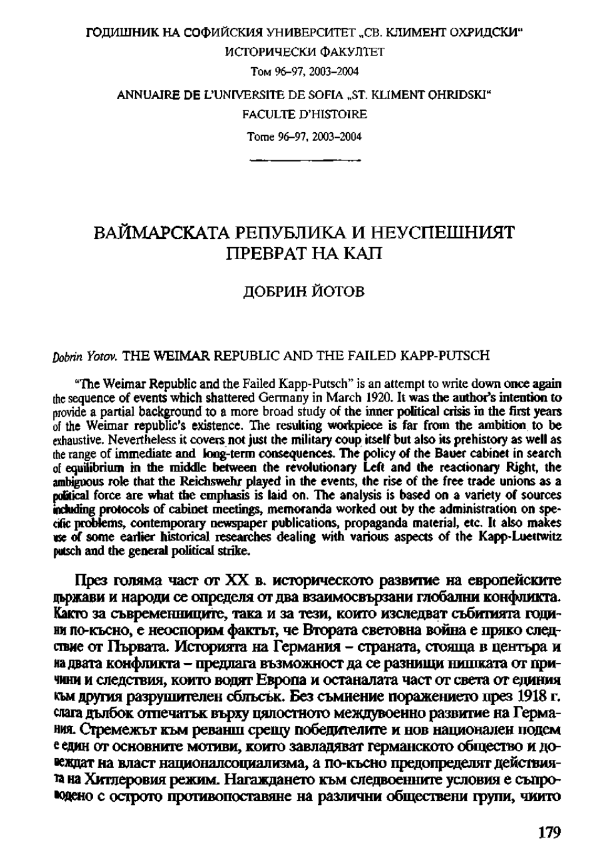
"The Weimar RepuЫic and the Failed Kapp-Putsch" is an attempt to write down оncе again the sequence of events which shattered Gennany in March 1920. lt was the author's intention to provide а partial background to а more broad study of the inner political crisis in the first years of the Weimar republic's existence. Тhе resulting workpiece is far from the ambltion to bе exhaustive. Nevertheless it covers not just the military coup itself but also its prehistory as well as the range of immediate and long-term consequences. The policy of the Bauer cablnet in search of equilibrium in the middle between the revolutionary Left and the reactionary Right, the ambiguous role that the Reichswehr played in the events, the rise of the free trade unions as а political force are what the emphasis is laid on. The analysis is based on а variety of sources including protocols of cablnet meetings, memoranda worked out bу the administration on specific problems, contemporary newspaper publications, propaganda material, etc. It also makes use of some earlier historical researches dealing with various aspects of the Kapp-Luettwitz putsch and the general political strike.
References
1. Спиридонов, В. Възход и падение. История на Германия 1914-1945. Велико Търново, 2004.
2. Рикард, Х. История на Германия. С., 1998.
3. Шмит, К. Германия и Първата световна война. Лондон, 1993.
4. Краузе, Р. Втората световна война: Стратегия и последствия. Мюнхен, 2000.
5. Петров, Т. Германският фашизъм: Исторически контекст и последици. С., 1985.
6. Хилберг, Р. Разрушената Европа. Прага, 1996.
7. Шулц, М. Германия в периода на Ваймарската република. Берлин, 2002.
8. Манн, Р. Политическа криза в Германия. Хамбург, 1991.
9. Краузе, А. Проблемите на германската икономика през 30-те години. Франкфурт, 2005.
10. Страус, Ф. Преходът към националсоциализма. Берлин, 1997.
11. Мюлер, Т. Възходът на Хитлер. Вена, 1989.
12. Браун, Л. Втората световна война: Германската стратегия. Лондон, 1994.
13. Спинели, П. Революцията и войната в Германия. Рим, 1987.
14. Грос, Х. Възход и падение на Третия райх. Ню Йорк, 2001.
15. Бергер, В. Национал-социализмът и германската нация. Мюнхен, 1999.
1. Spiridonov, V. Vazhod i padenie. Istoria na Germania 1914-1945. Veliko Tarnovo, 2004.
2. Rikard, H. Istoria na Germania. S., 1998.
3. Shmit, K. Germania i Parvata svetovna voyna. London, 1993.
4. Krauze, R. Vtorata svetovna voyna: Strategia i posledstvia. Myunhen, 2000.
5. Petrov, T. Germanskiyat fashizam: Istoricheski kontekst i posleditsi. S., 1985.
6. Hilberg, R. Razrushenata Evropa. Praga, 1996.
7. Shults, M. Germania v perioda na Vaymarskata republika. Berlin, 2002.
8. Mann, R. Politicheska kriza v Germania. Hamburg, 1991.
9. Krauze, A. Problemite na germanskata ikonomika prez 30-te godini. Frankfurt, 2005.
10. Straus, F. Prehodat kam natsionalsotsializma. Berlin, 1997.
11. Myuler, T. Vazhodat na Hitler. Vena, 1989.
12. Braun, L. Vtorata svetovna voyna: Germanskata strategia. London, 1994.
13. Spineli, P. Revolyutsiyata i voynata v Germania. Rim, 1987.
14. Gros, H. Vazhod i padenie na Tretia rayh. Nyu York, 2001.
15. Berger, V. Natsional-sotsializmat i germanskata natsia. Myunhen, 1999.
Downloads
Published
Issue
Section
Categories
License
Copyright (c) 2006 Dobrin Yotov

This work is licensed under a Creative Commons Attribution 4.0 International License.
Annual of Sofia University "St. Kliment Ohridski" - Faculty of History (GSU-IF).