САЩ, Австро-Унгария и Чехословашката кауза за независимост по време на Първата световна война
DOI :
https://doi.org/10.60053/GSU.IF.1.97.239-323Ключови думи :
Чехословашка независимост, Дипломация на САЩ, Австро-Унгария, Томаш Гарик МасарикАбстракт
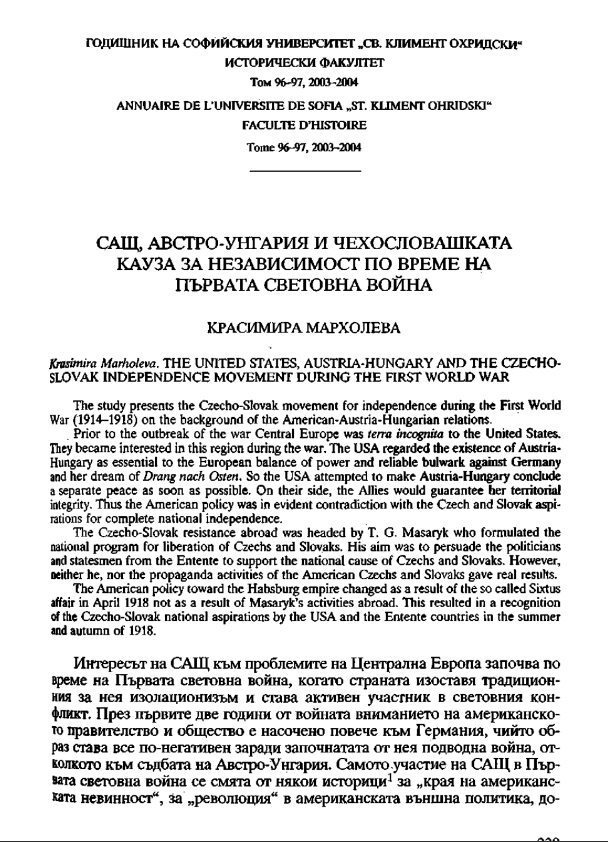
Изследването представя чехословашкото движение за независимост по време на Първата световна война (1914-1918) на фона на американско-австрийско-унгарските отношения.
Преди избухването на войната Централна Европа е те,та инкогнита за Съединените щати.
Тһеу се заинтересува от този регион по време на войната. САЩ смятат съществуването на Австро-Унгария за изключително важно за европейския баланс на силите и надежден бастион срещу Женева и нейната мечта за Drang nach Osten. Затова САЩ се опитват да накарат Австро-Унгария да сключи а отделна реасе възможно най-скоро. От тяхна страна съюзниците щяха да гарантират нейната териториална цялост. По този начин американската политика беше в явно противоречие със стремежите на Чехия и Словакия за пълна национална независимост. Чешко-словашката съпротива в чужбина се оглавява от бау Т. Г. Масарик, който формулира националната програма за освобождение на чехите и словаците. Целта му е да убеди политиците и държавниците от Антантата да подкрепят националната кауза на чехите и словаците. Нито той, нито пропагандната дейност на американските чехи и словаци обаче дават реални резултати. Американската политика спрямо Хабсбургската империя се променя в резултат на т.нар. афера „Сикст“ през април 1918 г., а не в резултат на дейността на Масарик в чужбина. В резултат на това през лятото и есента на 1918 г. САЩ и страните от Антантата признават чехословашките национални стремежи.
Литература (библиография)
Баева, И. Създателят на Чехословашката република Томаш Гарик Масарик – мислител, демократ, държавник. – Минало, 1995, № 2.
Петкова, П. САЩ, Световната война и мирната програма на президента Удроу Уилсън. – Годишник на Историческия факултет (ГСУ, ИФ), 89–90, 1996–1997, С., 2000.
Пантев, А. „Специалните отношения“ между Англия и САЩ по време на Първата световна война. – История и обществознание, 1986, № 2.
Пантев, А. Стратегически проекти за външната политика на САЩ в края на XIX – началото на XX век. – ГСУ, ИФ, 75, 1982.
Петкова, П. Нови акценти в американската външна политика от Гражданската война до Първата световна война. – История, 1996, № 3–4.
Петкова, П. Основни доктрини в американската външна политика в края на XVIII и началото на XIX век. – История и обществознание, 1988, № 5–6.
Петкова, П. САЩ, Световната война и мирната програма на президента Удроу Уилсън. – ГСУ, ИФ, 89–90, 1996–1997, С., 2000.
Вълков, Г. Томаш Гарик Масарик (7.03.1850 – 14.09.1937). С., 1937.
Гоповска, Т. Назад към изгубения трон. С., 1996.
Непшаева, З. Идейно-политическая борьба в Чехии и Словакии в начале ХХ века. Чехи, словаки и неославизм, 1898–1914. М., 1984.
Пантев, А., П. Петкова. САЩ и България в годините на Първата световна война. С., 1983.
Рубинщейн, Е. Крушение Австро-Венгерской монархии. М., 1963.
Трайнин, И. П. Национальные противоречия в Австро-Венгрии и ее распад. М., 1947.
Hanak, H. The Government, the Foreign Office and Austria-Hungary, 1914–1918. – The Slavonic and East European Review, XLVII, 1969.
Hemon, G. „Heinrich Lammasch’s Suggestion for Peace in Bern.“ – In: Heinrich Lammasch, seine Aufzeichnungen, sein Wirken und seine Politik. (Hrsg. von M. Lammash, H. Sperl). Wien, Leipzig, 1922.
Irmanova, E. Konec starého světa. – Slovanský přehled, LXXXVII, 2001, No 4.
Kalvoda, J. Masaryk in America in 1918. – Jahrbuecher fuer Geschichte Osteuropas, XXVII, 1979.
Keleher, E. „Emperor Karl and the Sixtus Affair.“ – East European Quarterly, XXVI, June 1992, No 2.
Kerner, R. The Winning of Czechoslovak Independence. – Foreign Affairs, VII, January 1929.
Kisch, G. Documents. Woodrow Wilson and the Independence of Small Nations in Central Europe. – Journal of Modern History, 1947, No 1.
Korallka, J. The Czech Question in International Relations at the Beginning of the 20th Century. – The Slavonic and East European Review, XLVIII, April 1970.
Kováč, D. Vývoj slovenských otázky medzi Dohodou a Centrálnymi mocnostami. – In: První světová válka a vztahy mezi čechy, Slováky a Němci. Brno, 2000.
Krizman, B. Austro-Hungarian Diplomacy before the Collapse of the Empire. – Journal of Contemporary History, IV, 1969, No 2.
Křen, J. Konfliktní společenství. Praha, 1990.
Long, J. et C. Hopkins. Document: T. G. Masaryk and the Strategy of Czechoslovak Independence: An Interview in Russia on 27 June 1917. – The Slavonic and East European Review, LV, January 1978.
Malone, G. War Aims Toward Germany. – In: Russian Diplomacy and Eastern Europe, 1914–1917. Ed. by Alexander Dallin, New York, 1963.
Mamatey, V. Documents: The United States Recognition of the Czechoslovak National Council of Paris (September 3, 1918). – Journal of Central European Affairs, XIII, April 1953, No 1.
Mamatey, V. Masaryk and Wilson: A Contribution to the Study of Their Relations. – In: T. G. Masaryk (1850–1937). Thinker and Critic., T. 2. Ed. by Robert B. Pynsent.
Mamatey, V. The Role of President Wilson in the Foundation of Czechoslovakia. – In: Czechoslovakia Past and Present, T. 1, ed. Miloslav Rechcigl, Hague, 1968.
Mamatey, V. The Slovaks and Carpatho-Ruthenians. – In: The Immigrants’ Influence on Wilsonian Peace Policies. Louisville, 1967.
Mamatey, V. The USA and the Dissolution of Austria-Hungary. – Journal of Central European Affairs, X, October 1950.
May, A. R. W. Seton-Watson and British Anti-Habsburg Sentiment. – The American Slavic and East European Review, XX, February 1961.
May, A. The Mid-European Union. – In: The Immigrants’ Influence on Wilsonian Peace Policies. Louisville, 1967.
May, A. Woodrow Wilson and Austria-Hungary to the End of 1917. – In: Festschrift für Heinrich Benedikt. Wien, 1957.
Miller, H. What Woodrow Wilson and America Mean to Czechoslovakia. – In: Czechoslovakia. Twenty Years of Independence. Los Angeles, 1940.
Odložilík, O. The Czechs. – In: The Immigrants’ Influence on Wilsonian Peace Policies. Louisville, 1967.
Ossulsky, S. The Secret Peace Negotiations between Vienna and Washington. – The Slavonic and East European Review, IV, March 1926.
Pichlík, K. Poválečná Evropa v představách T. G. Masaryka v exilu. – První světová válka a vztahy mezi čechy, Slováky a Němci. Brno, 2000.
Pomerance, M. The United States and Self-Determination: Perspectives on the Wilsonian Conception. – The American Journal of International Law, LXXVI, 1976.
Romsics, I. The Great Powers and the Dissolution of Austria-Hungary. – The Hungarian Quarterly, XLI, Autumn 2000, No 159.
Rysková, S. K případu Karla Perglera. – Český časopis Historický, LXXX, 1992.
Roberts, I. History of the School of Slavonic and East European Studies, 1915–1990. London, 1991.
Rothwell, V. British War Aims and Peace Diplomacy 1914–1918. Oxford, 1971.
Rychlík, J. Češi a Slováci ve 20. století, 1914–1945. T. 1. Bratislava, 1997.
Seton-Watson, H. The Making of a New Europe. R. W. Seton-Watson and the Last Years of Austria-Hungary. Seattle, 1981.
Seton-Watson, R. W. Masaryk in England. London, 1943.
Seymour, C. The Intimate Papers of Colonel House. T. 2. Boston, New York, 1926–1928.
Stuart, C. Secrets of Crewe House: The Story of a Famous Campaign. London, 1920.
Temperley, H. A History of the Peace Conference of Paris. T. 1. Oxford, 1969.
Tumulty, J. Woodrow Wilson as I Know Him. Gardein City, New York, Toronto, 1921.
Unterberger, B. The United States, Revolutionary Russia and the Rise of Czechoslovakia. Chapel Hill, London, 1989.
Valiani, L. The End of Austria-Hungary. London, 1973.
Voska, E. Československá Amerika v revoluci. Praha, 1924.
Voska, E. V., W. Irwin. Spy and Counterspy. New York, 1940.
Woodward, L. Great Britain and the War of 1914–1918. London, 1967.
Wilson, W. The State. Elements of Historical and Practical Politics. London, 1899.
Živojinović, D. America, Italy and the Birth of Yugoslavia 1917–1919. New York, 1972.
Baeva, I. Sazdatelyat na Chehoslovashkata republika Tomash Garik Masarik – mislitel, demokrat, darzhavnik. – Minalo, 1995, № 2.
Petkova, P. SASht, Svetovnata voyna i mirnata programa na prezidenta Udrou Uilsan. – Godishnik na Istoricheskia fakultet (GSU, IF), 89–90, 1996–1997, S., 2000.
Pantev, A. „Spetsialnite otnoshenia“ mezhdu Anglia i SASht po vreme na Parvata svetovna voyna. – Istoria i obshtestvoznanie, 1986, № 2.
Pantev, A. Strategicheski proekti za vanshnata politika na SASht v kraya na XIX – nachaloto na XX vek. – GSU, IF, 75, 1982.
Petkova, P. Novi aktsenti v amerikanskata vanshna politika ot Grazhdanskata voyna do Parvata svetovna voyna. – Istoria, 1996, № 3–4.
Petkova, P. Osnovni doktrini v amerikanskata vanshna politika v kraya na XVIII i nachaloto na XIX vek. – Istoria i obshtestvoznanie, 1988, № 5–6.
Petkova, P. SASht, Svetovnata voyna i mirnata programa na prezidenta Udrou Uilsan. – GSU, IF, 89–90, 1996–1997, S., 2000.
Valkov, G. Tomash Garik Masarik (7.03.1850 – 14.09.1937). S., 1937.
Gopovska, T. Nazad kam izgubenia tron. S., 1996.
Nepshaeva, Z. Ideyno-politicheskaya boryba v Chehii i Slovakii v nachale HH veka. Chehi, slovaki i neoslavizm, 1898–1914. M., 1984.
Pantev, A., P. Petkova. SASht i Bulgaria v godinite na Parvata svetovna voyna. S., 1983.
Rubinshteyn, E. Krushenie Avstro-Vengerskoy monarhii. M., 1963.
Traynin, I. P. Natsionalynыe protivorechia v Avstro-Vengrii i ee raspad. M., 1947.
Файлове за сваляне
Публикуван
Брой
Раздел (Секция)
Категории
Лиценз
Авторски права (c) 2006 Krasimira Marholeva

Публикация с Creative Commons Attribution 4.0 International License.
Годишник на Софийския университет "Св. Климент Охридски" - Исторически факултет (ГСУ-ИФ).