Отправни точки на веберовата интерпретация на религиите
DOI :
https://doi.org/10.60053/GSU.IF.KIsTK.78.184-205Ключови думи :
Макс Вебер, социология на религиите, религиозна етикаАбстракт
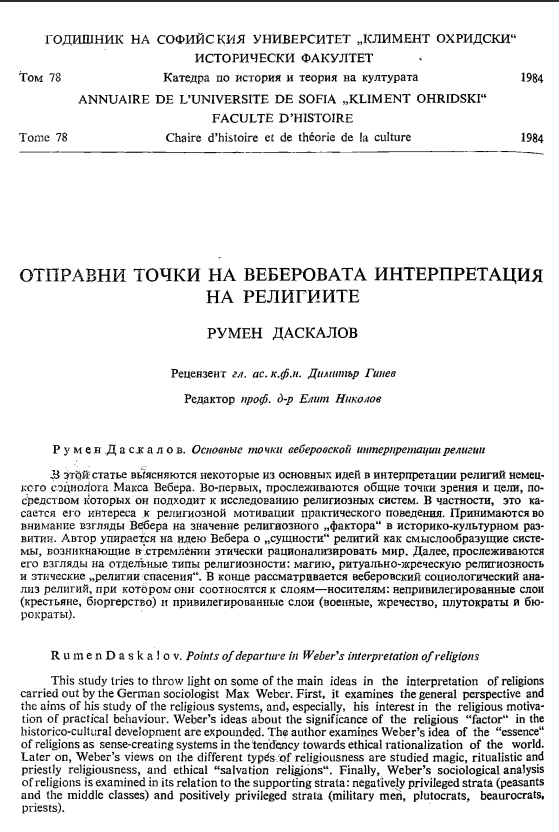
Това изследване се опитва да хвърли светлина върху някои от основните идеи в тълкуването на религиите извършено от германския социолог Вебер. Първо, той разглежда общата перспектива и целите на неговото изследване на религиозните системи и по-специално интереса му към религиозната мотивация на практическото поведение. Идеите на Вебер за значението на религиозния "фактор" в историко-културното развитие са разкрити. Essbase разглежда идеята на Вебер за "същността" на религиите като системи, създаващи сетива в тенденцията към етична рационализация на света. По-късно възгледите на Вебер за различните типове религиозност се изучават в магическата, ресталистичната и жреческата религиозност, и етичните „религии на спасението“.
Литература (библиография)
Wеbеr, М. Witchcraft und Gesellschaft. Tubingen, 1925
Frеund, J. The sociology of М. Wеbег. New York, 1968
Weber, М. Gesammelte Aufsiitze zur Religionssoziologie. Т. 1. Tiiblngen, 1922
Файлове за сваляне
Публикуван
Брой
Раздел (Секция)
Категории
Лиценз
Авторски права (c) 1988 Rumen Daskalov

Публикация с Creative Commons Attribution 4.0 International License.
Годишник на Софийския университет "Св. Климент Охридски" - Исторически факултет (ГСУ-ИФ).