Archives
-
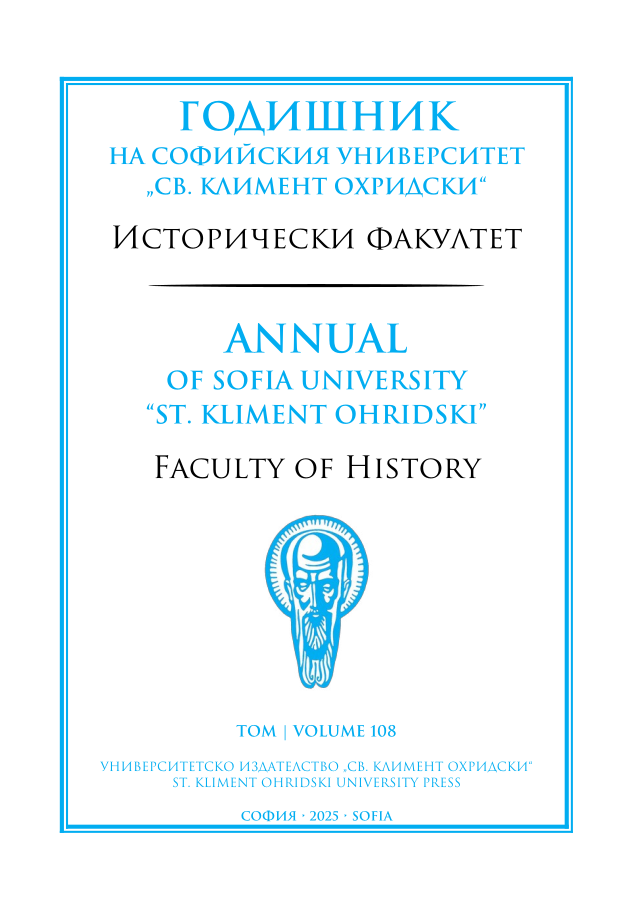
Annual of Sofia University "St. Kliment Ohridski" - Faculty of History
Vol. 108 No. 1 (2025)This volume constitutes an integrated interdisciplinary collection of studies that examine the historical evolution of the Balkans across broad temporal, methodological, and thematic dimensions — spanning from population-level genetic reconstructions of medieval societies to investigations of social changes during the socialist period of the twentieth century. The historical contributions explore critical aspects of medieval state-building, warfare, diplomacy, and religious policy, including the incorporation of Macedonia under Tsar Kaloyan, the Venetian and Latin involvement in the Fourth Crusade, the military agency of Villehardouin, and Byzantine–Bulgarian monastic relations, as well as reflections on Bulgaria’s international position in the post-World War II diplomatic arena. In parallel, the anthropological and ethnological studies provide rich empirical data based on field research along the Danube, addressing identity formation, linguistic heritage, community memory, ecological interactions, and migration-driven social configurations, with attention to groups such as Vlachs, Jews, Roma, and lifestyle migrants. Complemented by critical reviews and commemorative essays, the volume articulates a multidisciplinary vision of historical inquiry that synthesizes biological, cultural, and socio-political perspectives, and thereby contributes to a nuanced understanding of the enduring and transformative dynamics of Balkan societies.
-
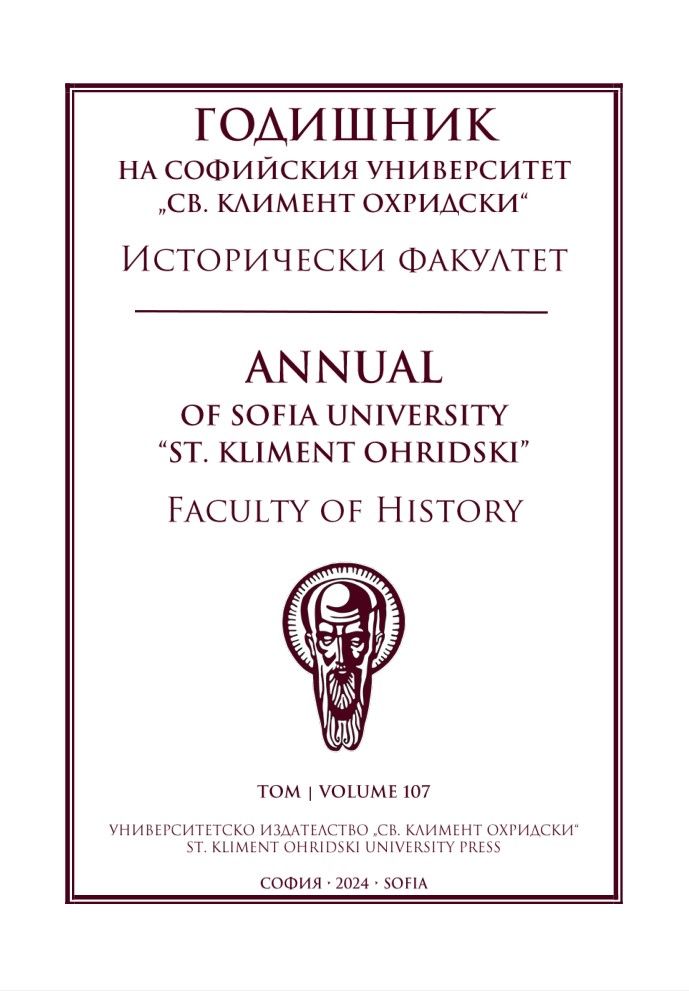
Annual of Sofia University "St. Kliment Ohridski" - Faculty of History
Vol. 107 No. 1 (2024)The 2024 edition of the Annual of the Sofia University - Faculty of History is volume 107., which contains seven publications, double-blind peer reviewed, and organized for the first time in accordance with the decision of the Editorial board, in three sections: Articles and Studies; Debuts; Reviews.
In this volume, the first section includes research on events, personalities and processes from the 15th century to our present day. Very well established on rich source material, they are historical and historical-anthropological in nature. Issues covered include: the complex relationship between Byzantium and the Vatican in the first half of the 15th century; in connection with the signing of the union between the Eastern and Western Churches (Ivayla Popova, 0000-0002-8972-0455); the fruitful friendly relations between the two prominent Bulgarian educators Petko Slaveykov and Hristo Daskalov (Vladimir Terziev, 0000-0002-0890-3066); the functioning of the specific state institution in Bulgaria, established in 1942. on Jewish issues (Vladimir Stanev, 0000-0002-2226-3632; Daniela Tasheva, ORCID 0009-0007-1317-1772); fieldwork regarding the Kalogeros custom in the village. Meliki, Greece, in order to track and analyze the changes in the customary-ritual system both in the specific settlement community and in the context of the Balkan reality (Mira Markova, 0000-0002-2891-0917; Ina Pachamanova, 0009-0001-1913-2228); the analysis of a magical tale from Breznishko according to the method of Vladimir Propp, with a hypothesis of existing groups of coal miners and soldiers during the Ottoman period in this region of Western Bulgaria (Nadia Manolova-Nikolova, ORCID 0000-0001-9203-1864).
The Debuts section presents an extensive and well-argued study of the peculiarities of Sulla's dictatorship, with excellently analyzed historical sources (Alexander Moskov, ORCID 0009-0006-3985-8890). No less interesting are the two materials in the Reviews section, with youthfully enthusiastic ideas and impressions (Andoni Andreev, ORCID 0000-0001-9675-2159; Elitsa Nenova, ORCID 0000-0002-1289-7201). -
Annual of Sofia University “St. Kliment Ohridski” – Faculty of History
Vol. 106 No. 1 (2022)Volume 106 is devoted to the celebration of several important anniversaries of the past of the Faculty of History at Sofia University: 134 years of University Readings in History; 102 years of the Department of Archaeology; 50 years of separate Faculty of History; 70 years of professional archival education, 20 years of the specialty of Archivistics and Documentary Studies at Sofia University. The introductory article by Prof. М. Markova, Dean of the Faculty of History, gives a brief and meaningful overview of the history of the faculty, its contributions to the development of Bulgarian historical knowledge and education, and to Bulgarian studies in general. Also introductory, in English text, is the article by Prof. H. Heppner, however, directed to the future of historical science. In the Articles and studies section there are chronological and thematic texts on a variety of topics: on the development of the specialty of Archivistics and Documentary Studies by Prof. An. Neykova; on the issues of staffing at the Faculty of History, by Prof. Ognyanov; Dr. Mukarzel published an article on the demon Lamashtu from the ancient Dvurechye; Dr. Tarhan discusses divination techniques from Ancient Mesopotamia. Several articles are devoted to problems of Balkan and Bulgarian history in the period of the Middle Ages and the Bulgarian Renaissance: on Bulgarian studies of Byzantine history by Prof. P. Schreiner; early Ottoman history through the text of Nicola Sagundino by Prof. Iv. Popova; and The Pirot Contributors in the 19th century by Prof. N. Manolova-Nikolova.
Noteworthy are also the four articles on the subject of recent and contemporary general history: on Vargas and the "yellow menace" by Dr. B. Miteva; on the USA and the Marshall Plan by Assoc. Prof. B. Stoyanov; on the problems of Argentina in the late 1980s and early 1990s by Assoc. Prof. G. Alexieva and "Mission Impossible" by Dr. Iv. Nikolova. The last two articles in the issue deal with important issues of state policy for the teaching of history in schools in the 5th grade by Assoc. Prof. G. Yakimov and on the importance of intercultural museum education by Prof. М. Markova and Dr. E. Vitanova. At the end of p. 106 the authors are listed in the order of the published articles.
-
Annual of Sofia University “St. Kliment Ohridski” – Faculty of History
Vol. 105 No. 1 (2020)Volume 105 of the GSU-IF has a preface, articles and studies dedicated to the 1000th anniversary of the establishment of the Bulgarian autocephalous archbishopric in Ohrid and the 120th anniversary of the birth of Prof. Vesselin Beshevliev. A list of abbreviations and data on the authors are placed at the end.
Contains an introduction by G. Nikolov and P. Pavlov; the study by Ang. Delikari on the jurisdiction of the Ohrid Archbishopric 1019-1767; the study by P. Pavlov on the Archbishopric of Bulgaria; the problems in the literature of the Ohrid Archbishopric by Il. Iliev; the Archbishopric of Ohrid at the time of the Despotism of Epirus by D. Tsiyman; documentary analysis by V. Karavalchev on the letters of Paisius of Ohrid to Metropolitan Timothy of Italy; M. Panov discusses the ideological conception of the Ohrid archbishopric of Tsar Samuel; Sts. Koyumdzhieva publishes notated monuments from the south-western Bulgarian lands up to the 15th century; the peripeteia surrounding the publication of the so called Dukanjo's list have been analyzed by L. Simeonova; Iv. Yovchev examines the church dioceses in Vardar Macedonia between the two world wars. These articles cover pp. 7 to 119.The second part of volume 105 contains articles dedicated to the 120th anniversary of the birth of the eminent Bulgarian scientist Prof. В. Beshevliev. Three of them contribute to the study of the professor's work - J. B. Beshevliev and Sn. Rakova for the work of prof. Beshevliev at the Institute of Balkan Studies; D. Petrova for Beshevliev's research on Byzantine sources on the reign of Khan Krum. The last article by T. Tomov discusses two graffiti from the Church of St. Sofia in Constantinople.
-
Annual of Sofia University "St. Kliment Ohridski" - Faculty of History
Vol. 104 No. 1 (2019)GSU-IF Volume 104 contains three studies dedicated to different topics of European and Bulgarian history in the 19th and 20th centuries. M. Simov examines the changes and actions of Russian military intelligence after Russia's loss in the Crimean War of 1856, mainly in the period until the beginning of the Eastern Crisis, using a variety of documentary material. L. Krastev clarifies the impact of the large smallpox epidemic during the Franco-Prussian war of 1870 - 1871, posing the question of the role of diseases in critical times for societies. The third study by T. Borisov is dedicated to the policy of the Bulgarian Communist Party towards Bulgarian football from 1944 until the fall of communism in 1989. At the end of the volume there is information about the authors.
-
Annual of Sofia University "St. Kliment Ohridski" - Faculty of History
Vol. 103 No. 1 (2019)T. 103 contains, first of all, the article based on the academic speech of Prof. Dmitry Polivyanni /Ivanovsky University - Russia/ at his awarding of Doctor honoris causa on May 18, 2018 in the Auditorium of Sofia University. The article examines the communities of spirit in the Bulgarian Middle Ages, which created specific network structures, with a special reverence for the relationship between teacher and student. The article by El. Musakova refers to the manuscript called Banishko evangelie, re-problematizing the questions about the place of its creation and about its author. T. Popov presents an article about the influence of the Bulgarian state tradition on the institutions of the Danubian principalities - Wallachia and Moldavia for the period XIV - XVII centuries. The influence is traced through the adopted titles in the principalities and institutions, similar or identical to those in the Bulgarian state. The material by M. Belcheva reflects the restoration process of one of the books that belonged to Sophronius Vrachanski, as well as the author's reflections on the movement of this book by Goddard Friedrich Stender /1714 - 1796/ True religions..., on the notes placed on her pages etc. The last study in the issue by J. Madzharov examines in detail the difficult fate of the famous Hungarian Bulgarian writer Shara Karig/1914-1999/ and her contributions to the popularization of Bulgarian culture in Hungary.
Digitized and provided by University Library "St. Kliment Ohridski".
-
Annual of Sofia University "St. Kliment Ohridski" - Faculty of History
Vol. 102 No. 1 (2017)GSU 102 is dedicated to the 90th anniversary of the birth of the famous Bulgarian historian Evlogi Buzhashki. Its diverse content includes articles on Bulgarian history and that of the Ottoman Empire. Al. Nikolov analyzes the valuable work of Hayton of Korikos "History of the Tatars" and applies a translation completely prepared from the Latin text published in 1906. N. Ivanov examines the policy of France and the activities of the Jesuit Order for education in the Ottoman Empire from 1835 to The First World War. V. Racheva clarifies the main moments of Yu. Venelin's biography in the context of her research on the role of historians and history in Russia's policy of establishing lasting influence in the Balkans and over the Bulgarians. On the basis of the newly discovered, hard-to-access documents from the Russian Empire Foreign Policy Archive, I. Makarova traces the history of the signing of the Budapest Convention of 1877, as an important moment in the Eastern Crisis and the preservation, with the expansion, of Russian influence in the Balkans. V. Yanchev examines the politics of Al. Stamboliyski in the period 1919-1920 in relation to his political opponents and the role of the Bulgarian army. Pl. Stoyanova presents an analytical text on the employment policy among the Gypsy population in Bulgaria during socialism /1945 - 1989/. V. Mihailova's article clarifies the impact of the shooting down of an Israeli plane on 27.07.1955 on Bulgarian-Israeli relations. Information about the authors is included at the end of the volume.
Digitized and provided by University Library "St. Kliment Ohridski".
-
Annual of Sofia University "St. Kliment Ohridski" - Faculty of History
Vol. 101 No. 1 (2013)Volume 101 of GSU - IF contains a variety of studies from the Middle Ages to our modern world. The study of V. Garkova examines the work of Archbishop Hinkmar of Rheims "DE ORDINE PALATII" (882) to characterize Charlemagne's court as a governing institution. Kr. Gagova discusses in detail the complex relations between the pilgrim-crusaders who set out for the Holy Sepulchre and the local Christian population. Е. Mihailova published a study on the Bulgarian graduates of the Imperial Military Medical School in Constantinople from 1827 to 1878. Liberatos develops the little-known topic of time and its measurement in Bulgaria during the Ottoman period, understanding the adoption of clocks as a socio-cultural transformation. I. Kaliganov discusses the specifics of the 19th century Russians' view of Bulgarian existence and national character. In the extensive study of Sv. Zhivkov elucidates the many challenges facing the Progressive Liberal Party in opposition in Bulgaria in the period 1903 to 1911. D. Hristov examines in detail the biography and writings of the famous Bulgarian researcher prof. Ivan Snegarov.
-
Annual of Sofia University "St. Kliment Ohridski" - Faculty of History
Vol. 100 No. 1 (2012)Vol. 100 of the GSU-IF contains articles and studies with a chronological range from the first millennium BC to our modern times; the materials are published in Bulgarian and English. P. Delev analyses a variety of sources and offers his own theses on a number of controversial points in the history of the Thracian tribe Besi. S. Ivanova published an article which deals with the peculiarities of the status of merchants in the Ottoman Empire in the XVII-XVIII centuries. V. Racheva clarifies the details of the emigration policy of Russia in the 1820s in the Balkans and towards the Bulgarians in connection with the Peace of Adrianople in 1829. D. Kontogeorgios promulgates two Greek documents from 1855, which bring into scholarly circulation new information about the life of the prominent Bulgarian revolutionary G. Rakovski and his Greek citizenship in 1843. Thematically related to the material of V. Racheva is the ethnological study of T. Boneva, devoted to two villages in Moldova, with extremely interesting observations and analysis tracing the history of the settlers from the establishment of the new settlements to the Soviet and post-Soviet times. Evg. Kalinova examines the Bulgarian intelligentsia and the communist regime in the period 1960-1963, outlining new trends in the social and cultural life of the country. I. Baeva defends the thesis of the return of the European constitutional tradition in the public life of Bulgaria after the changes of 1989.
-
Annual of Sofia University "St. Kliment Ohridski" - Faculty of History
Vol. 95 No. 1 (2002)Volume 93-95 contains materials on topics from modern and contemporary history, as well as ethnology. All are accompanied by summaries in Russian and English. B. Georgieva traces the emergence and establishment of sport after the Liberation of Bulgaria as a social and cultural phenomenon. M. Markova proposes a typology of the specific characteristics of villages in the Central Balkans in Bulgaria in the process of transition from a traditional to a contemporary way of life. T. Karamelska analyzes the role of Ernst Tröltsch's journalism in the political reforms in Germany between 1914 and 1923. M. Gruev examines the process of the violent destruction of the Rodina organization of Bulgarian Muslims and the establishment of a new communist policy towards them between 1944 and 1948. R. Botev traces Winston Churchill's policy for the creation of a Council of Europe during World War II (1940-1945).
-
Annual of Sofia University "St. Kliment Ohridski" - Faculty of History
Vol. 92 No. 1 (2003)The double volume 91–92 of GSU-IF (1998–1999; Sofia, 2003) brings together studies that traverse a broad chronological arc—from early medieval state formation to twentieth-century socio-political change. The opening article examines state-building in France, England, and Germany during the 5th–9th and 11th–13th centuries, highlighting the institutionalization of power, the centrality of monarchy, and the interplay between Germanic traditions and the late Roman legacy. Subsequent contributions reassess the political history of medieval Bulgaria through Georgi D. Balaschev’s scholarship and survey the achievements of Academician Veselin Hadzhinikolov in general medieval studies, while Valeri Katzunov focuses on acts of Bulgarian ethnic self-consciousness under Byzantine rule. The volume then turns to historiography and history teaching with a didactic reading of the Balkan Wars (1912–1913) in scholarly works and school textbooks, and concludes with modern social and political history through an analysis of the municipal administrative corps and practices in Bulgaria under the Democratic Entente (1923–1931). Overall, the collection presents a methodologically pluralist panorama that interweaves comparative medieval perspectives, historiographical reflection, and empirically grounded studies of institutions and policy in modern and contemporary times.
-
Annual of Sofia University "St. Kliment Ohridski" - Faculty of History
Vol. 90 No. 1 (1997)The double volume 89–90 of the Annual of Sofia University “St. Kliment Ohridski” – Faculty of History, presents studies tracing the cultural and political evolution of Bulgarian identity from Late Antiquity to the modern era. The contributions reflect the interdisciplinary orientation and methodological diversity of Bulgarian historical scholarship at the turn of the 21st century.
The opening article by Stanislava Stoycheva examines the cross symbols in the sepulchral painting of Serdica (4th–6th centuries) as a source for early Christianity, applying statistical and typological analysis to the archaeological evidence. Valeri Katsunov explores the formation and development of Bulgarian ethnic self-consciousness between the 7th and 10th centuries, focusing on linguistic and cultural identity in the early medieval period.
Petko Petkov analyses the role of the United States and President Woodrow Wilson’s “Fourteen Points” in shaping post–World War I international relations and the idea of national self-determination. Two studies by Valeri Kolev address the socio-political tensions in interwar Bulgaria — the struggle between the Democratic Entente and the opposition for control over municipal government (1926–1931), and the housing question during the Entente’s rule.
The volume illustrates the continuity and pluralism of Bulgarian historiography, uniting archaeological, medieval, and contemporary political studies into a coherent intellectual panorama. It stands as a testament to the enduring academic tradition of the Faculty of History at Sofia University and its commitment to critical, evidence-based scholarship.
-
Annual of Sofia University "St. Kliment Ohridski" - Faculty of History
Vol. 88 No. 1 (1995)Volume 88 of GSU-IF brings together studies spanning from the fifteenth to the twentieth century, united by a focus on the historical evolution of Bulgarian society, its territorial and cultural space, and the broader Balkan context. The opening studies (by Tsvetana Georgieva, Valeri Katsunov, and Plamen Mitev) explore the boundaries of the Bulgarian historical space under Ottoman rule, the development of ethnic self-consciousness, and Bulgarian participation in transregional commercial networks. Later contributions shift toward national and political history: Nadezhda Angelova examines the Macedonian Question in the policies of Stambolov’s government and the Bulgarian Exarchate (1887–1894), while Krasimira Tabakova analyses the Bulgarian Social Democratic Party’s involvement in the Macedonian and Thracian liberation movements (1903–1908). Gergana Velichkova discusses the concept of a “national community” as a model for political and moral renewal, and Veselin Tepavicharov studies the formation of individual agrarian holdings in Bulgaria’s mountain and semi-mountain regions during the twentieth century. The volume demonstrates the thematic breadth and methodological pluralism of contemporary Bulgarian historiography, combining political, social, and anthropological approaches to the study of the nation and its historical space.
-
Annual of Sofia University "St. Kliment Ohridski" - Faculty of History
Vol. 87 No. 1 (1994)Vol. 87 of Annual of Sofia University “St Kliment Ohridski” – Faculty of History brings together seven studies spanning Antiquity to the late 20th century, combining source-based rigor with theoretical inquiry. D. Popov reinterprets the Hellenic narrative of Zalmoxis, reconstructing a two-stage initiatory pattern — the andreon (male, esoteric setting) and a subterranean dwelling/cave — as horizontal and vertical passages between death and rebirth, aligned with Greek–Thracian ritual models. D. Boteva, using literary, numismatic and epigraphic evidence, refines the chronology of Lower Moesian governors (Longinus, Pontianus, Agrippa) under Macrinus (A.D. 217–218), argues for early military tensions in the east of the province, and a likely visit of Diadumenian to the Lower Danube limes. E. Mihailov frames Kievan Rus’ as a cultural phenomenon (intellectual and civilizational linkages). G. Nazarska, drawing on untapped archives, memoirs, and the press, reassesses Gavril Krŭstevich’s tenure as Governor General of Eastern Rumelia (1884–1885), the institutional balance among governor, cabinet, Provincial Assembly and Permanent Committee, and the practical shift toward economic policy and administrative consolidation. J. Todorov reports an empirical survey (questionnaire with graded scales) of historical consciousness in Sofia, Haskovo, Stara Zagora and Varna (1993), highlighting implications for history teaching and the role of socio-demographic factors. Theoretical essays by R. Donkov (history as paradigmatic reality) and Zh. Stoyanov (on the nature and limits of history-theoretical knowledge) position the discipline within classic and contemporary debates. The volume is edited by a board led by Prof. Georgi Bakalov and issued by Sofia University Press (ISSN 0204-4005).
-
Annual of Sofia University "St. Kliment Ohridski" – Faculty of History
Vol. 86 No. 1 (1993)Volume 86 (1993) of the Annuaire de l’Université de Sofia “St. Kliment Ohridski” – Faculty of History contains a selection of studies covering diverse fields: prehistory, classical and medieval archaeology, cultural and social history, and modern European developments. The volume exemplifies the Faculty’s multidisciplinary scope and its emphasis on empirical fieldwork combined with theoretical analysis. Petya Georgieva reports on excavations at the prehistoric settlement near Negovantsi, Radomir region, attributed to the Krivodol–Sălkuca and Magura–Coțofeni cultures, documenting pile-dwellings from the Late Chalcolithic and Early Bronze Age. Dimiter Popov explores Zalmoxis–Gebeleizis and the ritual of bow-shooting, interpreting the Thracian cult as a mythic reflection of the Thunder God and the notion of immortality. Stefka Angelova presents findings from a medieval cemetery at the southern wall of Drăstăr (Silistra), providing insight into burial customs and material culture of the 11th–12th centuries. Slavcho Cholakov conducts an anthropological study of the same cemetery, examining skeletal morphology and population health. Pavlin Dimitrov analyzes the cultural and social characteristics of the Bulgarian feudal town during the 13th–14th centuries, based on sgraffito pottery as a source for urban life. Veselka Garkova studies Saxony and Southeastern Europe between the 15th and 17th centuries, focusing on economic and cultural relations. Pavlina Yosifova discusses the Baltic Question in the Russian Empire during the 1860s, emphasizing government policies and Slavophile influence. Tanya Boneva offers a symbolic–anthropological interpretation of the “podnitsa” (bread-baking tray) as a model of the world in Balkan peasant communities, highlighting its semantic and functional role in traditional culture.
The volume reflects the research diversity of the Sofia University Faculty of History — linking archaeological evidence, cultural interpretation, and historiographical inquiry from prehistory to the modern age.
-
Annual of Sofia University "St. Kliment Ohridski" - Faculty of History
Vol. 85 No. 1 (1992)The double volume 84–85 of GSU-IF encompasses a broad chronological and thematic spectrum—from prehistory and antiquity to modern political and intellectual history. It showcases the methodological diversity and academic vitality of the Faculty’s research in the 1990s.
The archaeological section (Krasimir Leshtakov, Dimitar Popov, Rumyana Koleva) deals with the stratigraphy of Early Bronze Age settlements in Thrace, the religious practices associated with Zalmoxis, and the dating of early Slavic groups in Northeast Bulgaria and Northern Dobruja.
The modern and contemporary studies include Iskra Baeva’s comparative analysis of agrarianism as an ideology in Bulgaria and Poland before World War II, Alexander Lunin’s research on Russian emigration in Bulgaria during the 1920s, and Rumen Donkov’s study of nationalism, apartheid, and opposition in South Africa’s parliament (1948–1970). Adriana Neikova’s paper surveys the projects and programmes for collecting and publishing archival documents on Bulgarian history, emphasizing their historiographical significance.
Through these varied perspectives, the volume highlights the continuity of historical inquiry — from empirical archaeological investigation to socio-political and theoretical analysis — reflecting the dynamic and interdisciplinary character of Bulgarian historical scholarship at the turn of the millennium.
-
Annual of Sofia University "St. Kliment Ohridski" – Centre for Culturology
Vol. 83 No. 1 (1990)Annual of Sofia University “St Kliment Ohridski” — Centre for Culturology is a thematic issue dedicated to Prof. Atanas Natev, opening with a biographical note on his career and international recognition (including the Gottfried von Herder Prize) and a comprehensive bibliography of his works compiled by Stefka Piskuliyska and Krassimira Daskalova.
The core articles span aesthetics, cultural theory, theatre studies, anthropology, and the mythologization of historical memory. Valentin Angelov advocates a culturological account of the artistic image beyond narrow epistemology; Angel Angelov & Dimitri Dotschev reassess Leo Spitzer’s psychostylistics through hermeneutics; Yana Hashamova outlines methodological approaches in theatre theory; Sonia Asenova sketches a logic-epistemological profile of ecological anthropology; Dimitri Ginev proposes a typology of culture theories (Part I); Evgenia Ivanova traces how “real” historical figures are transformed in legend and epic.
Two contributions expand the scope internationally: Iris von Bredow presents Part I of a study on Old Anatolian (Hittite) deities based on ritual texts, and Christopher Read examines the Russian intelligentsia and the October Revolution — mapping attitudes, social conditions and fates. The volume thus bridges local and global perspectives on culture, textuality, and historical remembrance.
-
Annual of Sofia University "St. Kliment Ohridski" – Faculty of History
Vol. 82 No. 1 (1989)Volume 82 of the Annual of the Faculty of History, Sofia University “St Kliment Ohridski” presents a broad thematic scope, encompassing European and Bulgarian history as well as twentieth-century political and intellectual developments.
The opening group of articles focuses on comparative studies of political systems and ideologies.
Dragomir Draganov analyses the rise of Spanish fascism (1931–1936) within the framework of European totalitarian movements, highlighting its distinctly national character. Kostadin Grozev examines reform efforts within the U.S. Democratic Party (1969–1971), tracing the adaptation of liberal traditions to changing social realities.Further contributions address international and regional dimensions of history.
Borislav Gavrilov reconstructs British public opinion and foreign-policy attitudes during the Austro-Prussian War of 1866. Daria Krachunova studies “Black Islam” in West Africa as a socio-political phenomenon blending traditional religious structures with modern ideological frameworks.Valeri Katsunov’s paper contributes to medieval studies and historical anthropology, analysing the evolution of Bulgarian national consciousness during the Second Bulgarian State and the formative impact of both church and state institutions.
Overall, the volume demonstrates the high level of interdisciplinarity achieved in historical scholarship at the close of the 1980s, combining political history, sociology, cultural studies, and the history of religion. It reflects the sustained research activity of the departments of General and Bulgarian History at Sofia University.
-
Annual of Sofia University "St. Kliment Ohridski" - Faculty of History
Vol. 81 No. 1 (1988)Vol. 81 contains a variety of materials on archaeology, history, and ethnography. Chronologically, they cover the period from the Middle Ages to the present day. The studies are accompanied by summaries in Russian and English. Ev. Kalinova examines Bulgaria's cultural policy in the second half of the 1950s towards European capitalist countries. T. Boneva typologizes the rituals with anthropomorphic figures in the Bulgarian traditional custom system. M. Yonov traces the Bulgarian uprisings in the 16th-17th centuries and the European political situation. Y. Kolev analyzes the formation of the Bulgarian intelligentsia after the Liberation of 1878-1900. The archaeological publication by At. Milchev provides data on the water supply and water supply network of the medieval Bulgarian city of Pliska.
-
Annual of Sofia University "St. Kliment Ohridski" – Faculty of History
Vol. 80 No. 1 (1987)The 80th anniversary volume of the Sofia University Yearbook – Faculty of History marks the centenary of the History program (1888–1988) and provides a comprehensive academic overview of the development, institutionalization, and scientific achievements of the departments in the Faculty of History. The articles, written by leading faculty members, chronologically trace the formation of the major from the Higher Pedagogical Course (1888) to the establishment of an independent Faculty of History (1972) and its current state.
Prof. Rumen Donkov examines the hundred-year development of the History major, analyzing the institutional and ideological changes from the Higher School through the Faculty of Philosophy and History to its current structure. Prof. Velichko Georgiev presents the history of the Department of Bulgarian History, outlining the main schools and contributions of scholars such as Petar Mutafchiev, Vasil Zlatarski, Hristo Gandev, Nikolay Todorov, and others. Prof. Velizar Velkov summarizes the development of the Department of Ancient History, its classical and antique traditions, and international contacts. Assoc. Prof. Aneta Ilieva traces the creation and development of the Department of Byzantine and Balkan History (1972–1986), emphasizing the contributions of Georgi Bakalov, Vasilka Tapkova-Zaimova, and other prominent Byzantinists. Assoc. Prof. Dimitar Polov presents the Department of Thracology, built around the research of Prof. Alexander Fol and his school. Assoc. Prof. Mihail Yonov examines the teaching of medieval general history, and Assoc. Prof. Milen Semkov discusses the activities of the Department of Modern and Contemporary History, associated with the works of Academician Dimitar Kosev and Prof. Vera Mutafchieva. The article by Chavdar Naydenov, Iskra Ilieva, and Rumyana Radenska traces the traditions and continuity in the teaching of Russian and Soviet history. Prof. Lyudmil Getov presents the history of the Department of Archaeology, while Assoc. Prof. Ivanichka Georgieva discusses the development of ethnography at the university in the context of cultural anthropology. Finally, Prof. Yordan Shopov and Stefka Petkova examine archival science and auxiliary historical disciplines as an autonomous field of study and research.
The volume emphasizes the place of Sofia University as a center of historical science in Bulgaria and shows the continuity between generations of teachers and scholars who have contributed to the development of the national historiographical tradition.
-
Annual of Sofia University "Kliment Ohridski" - Faculty of History
Vol. 79 No. 1 (1988)Volume 79 of the Annual of Sofia University “Kliment Ohridski” — Faculty of History (1988) comprises four scholarly articles addressing diverse historical themes and periods. Lilia Simeonova analyses contemporary West European Byzantinology and its debates on the conceptual continuity between Antiquity and the Middle Ages. Georgi Sotirov examines the relations between the Frankish state and the Polabian–Baltic Slavs in the ninth century, focusing on their political and cultural interactions. Plamen Mitev studies France’s role in the export of wool from the Bulgarian lands during the eighteenth century and its broader economic implications. Elka Drosneva explores the representation of Lyuben Karavelov in Soviet encyclopaedic publications and university courses in the humanities, revealing the ideological framing of the Bulgarian National Revival. The volume reflects the thematic and methodological diversity of the research conducted at the Faculty of History during the 1980s.
-
Annual of Sofia University "Kliment Ohridski" - Faculty of History. Chair of History and Theory of Culture
Vol. 78 No. KIsTK (1984)Vol. 78K contains materials from the Department of History and Theory of Culture, Sofia University. R. Yordanova shares her observations and interpretations of zoomorphic stone sculptures from the medieval Bulgarian cities of Pliska and Preslav. N. Genchev publishes statistical data on the Bulgarian medieval intelligentsia. In an extensive study, Aks. Dzurova examines the formation of two main types of culture—Eastern Orthodox and Catholic—as well as their role in Bulgarian cultural development. D. Avramov analyzes the problem of national identity in Bulgarian art from the 1920s. At. Natev highlights the multidimensional project reality in the work of A. Lunacharsky. In his study, Iv. Znepolski focuses on the main postulates in the work of Walter Benjamin and the discussion on the nature of contemporary culture. El. Nikolov examines the social prerequisites and the formation of the concept of comparative cultural studies. D. Ginev traces the historical dynamics of non-Marxist cultural studies. R. Miteva's article draws important information from foreign travelogues about urban culture during the Bulgarian Renaissance. In a short study, R. Daskalov clarifies the main points of Weber's interpretation of religions. T. Vucheva offers an interesting parallel between the work of Tintoretto and the natural philosophy of Francesco Patizi of Venice in the 16th century. Vl. Nestorov publishes an article devoted to problems related to the ontology of artistic culture.
-
Annual of Sofia University "St. Kliment Ohridski" - Faculty of History
Vol. 78 No. 1 (1985)Vol. 78 contains historical studies, chronologically arranged from Ancient Mesopotamia to modern Bulgaria. The materials are accompanied by summaries in Russian and English. In an extensive study by Vl. Popov, slavery in the cuneiform legislation of Eshnuwa, 3rd millennium BC in Ancient Mesopotamia, is examined. D. Popov analyzes the royal institution among the Thracians as part of his larger study on Thracian religion. The text by Y. Nikolov presents the author's thesis on the influence of feudal relations in Italy, France, and Germany in the 12th-13th centuries on religious heretical movements. I. Ilieva examines the influence of the Moscow chronicle on the formation of the ideology of Russian autocracy. The publication by St. Trifonov traces the development of the refugee issue after the first national catastrophe for Bulgaria in 1913-1915. Hr. Stefanov's detailed study examines the political relations in bourgeois Bulgaria between the radical democrats and the Bulgarian Workers' Socialist Party, the wing of the so-called narrow socialists - the BRSDP (Narrow Socialists). S. Popov analyzes the complex relationships between the Bulgarian Workers' Party (Communists), the Union of Bulgarian Writers, and the opposition in the postwar period from 1945 to 1947.
-
Annual of Sofia University "Kliment Ohridski" - Faculty of History
Vol. 77 No. 1 (1984)Issue 77, No. 1 contains materials covering periods from Antiquity, the Middle Ages, the Modern Era, and the present day in chronological order. The historical topics are diverse, including the issue of information services for science. The articles and studies are accompanied by summaries in Russian and English. D. Popov examines the secret Thracian societies as a particularly important component of the Thracian religion. T. Stoyanov's article offers the first attempt at a more complete study of the cult of Artemis in the cities of Western Pontus in the period from the 7th century BC to the 3rd century AD. In an extensive study, St. Angelova presents the local traditions in domestic ceramics from Northeastern Bulgaria in the 7th-10th centuries. M. Kaymakamova's article analyzes the sources and their dating used in the Bulgarian Short Chronicle in the Middle Bulgarian translation of Manasses' Chronicle. St. Doynov examines in his study the changes that took place in Russia and the Bulgarian political movements from the end of the 18th to the beginning of the 19th century. Dr. Draganov's study offers an analysis of the main activities of the Spanish Communist Party at the time of its political legalization in 1976-1977. Ch. Naydenov examines the theoretical ideas of the 1930s in the USSR about Soviet society after the victory of socialism. A short study by D. Krachunova presents the ideas of Léopold Sédar Senghor on "African socialism." El. Kirova provides a comprehensive review of the library of Prof. Marin Drinov. The study by Z. Petkova outlines the main moments in the development and changes in information science in Bulgaria.
-
Annual of Sofia University "Кliment Ohridski" - Faculty of History
Vol. 76 No. 1 (1983)Vol. 76, No. 1 contains articles and studies, chronologically arranged from Antiquity, the Middle Ages, and Modern Era, with topics from the history of the Thracians, Bulgaria, and ancient Russia. The materials are accompanied by summaries in Russian and English, as well as the names of the reviewer and editor of the respective manuscript. The article by H. Danov is devoted to the earliest manifestations of Greek colonization in Aegean Thrace, in the area between the Mesta and Maritsa rivers. In his study, D. Popov offers his interpretation of the Thracian religion in relation to the symbolic meanings of feasts, banquets, and gifts. M. Tacheva's article examines important issues in the political history of the Thracians for the period 2nd century BC - 45 AD. In an extensive study, At. Milchev presents the results of archaeological research in the village of Batoshevo, Gabrovo district, covering the period from the 1st to the 14th century. M. Kaymakamova provides a study review, translation, and commentary on the Bulgarian Short Chronicle in the Middle Bulgarian translation of Manasseh's Chronicle. In a study devoted to the concept of heresy, Y. Nikolov explains its emergence in antiquity and its development during the Middle Ages. St. Trifonov analyzes the administrative structure and governance of Western Thrace in 1913-1915. M. Radeva's study examines the problem of forming a scientific worldview through teaching students native history. The last study by Galina Taseva is in Russian with a summary in English, devoted to the changes in Russian agriculture at the end of the 18th and beginning of the 19th centuries.